L'articolo Wikipedia 4 Refugees – a digital experimental project for asylum seekers proviene da Get Close To Opera.
]]>At the end of the summer in 2017, in Trento, a city in Northern Italy, a group of teachers, digital right activists and members of the local Wikipedia community came together to organize a course dedicated to teaching to recently arrived asylum seekers how to contribute to Wikipedia in their own languages. The initiative, called Wikipedia4Refugees, was born after a two years long experience in teaching digital literacy classes to groups of migrants, in which the teachers noticed the enthusiasm the students – mostly from western Africa and southern Asia and with no or little formal education – showed when they learned they could read the encyclopaedia not only in Italian, French of English, but also in their own native languages.
Thanks to a small grant from the Wikimedia Foundation – an organization that supports grassroots initiatives in and around the community of Wikipedia contributors – and the logistic support of the local university, the course started in October 2017. The students were first shown the functioning of Wikipedia and of its system of open contributions, in which everybody, after creating an account, can modify an existing article or add one anew, provided that it respects the rules that the community gave itself. Then, they were guided in the process of selecting one article from the Italian version of the online encyclopaedia. Articles could be about refugees rights, the organization of Italian civic society, or local cultural heritage. After making sure these articles had no counterpart in the Wikipedia edition of the students’ native languages (Fula, Bambarà, Pashto, and Urdu), the translation work began. After a few weeks, the students were ready to publish their articles.
The project was highly experimental, as it combined innovative teaching methods (based on the active participation of the students and on the use of activities offline to convey principles related to the online), an alternative use of the Internet (based on active, high-quality participation) and contamination between very different cultures for what concerns the way information is created, received, and interpreted (using Wikipedia as a reliable media source and working to improve it.) The objective was primarily to make the students aware of their power as creators of information and involve them in a collaborative effort of knowledge-building – one in which everyone has the same voice and there is no distinction between being a migrant or a local, speaking Italian or an African language. An added challenge was the degree of technical knowledge required to be able to contribute to Wikipedia: the students knew how to use a computer, but had to learn the special language in which Wikipedia pages are built.
One of the most interesting moments of the course was to compare the different ways authority plays a role in the creation of information. During an in-class discussion on the way consensus is reached regarding what can and cannot live on Wikipedia – especially in case of controversial articles –, many students were surprised to learn that there is no central authority deciding on these matters, but that decisions are reached through the continuous interaction among the members of the community. After an expert Wikipedia user was struggling to describe the process to the class, one of the students stood up and asked, sincerely baffled: “All this is all good and right, but in the end: who has the Truth”? We, the teachers, had no answer. But it reminded us that it is the questions we keep on asking ourselves, beyond any cultural, political or territorial barrier that make us all fundamentally human.
Learn more about Wikipedia4Refugees
Martina Puppi, Rossella Vignola
Photo credit: Rossella Vignola / Wikimedia Commons – Participants to the “Digital Skills 4 Refugees” Spring 2017
L'articolo Wikipedia 4 Refugees – a digital experimental project for asylum seekers proviene da Get Close To Opera.
]]>L'articolo Social Inclusion: Inspiring Trends in European Funded Projects. proviene da Get Close To Opera.
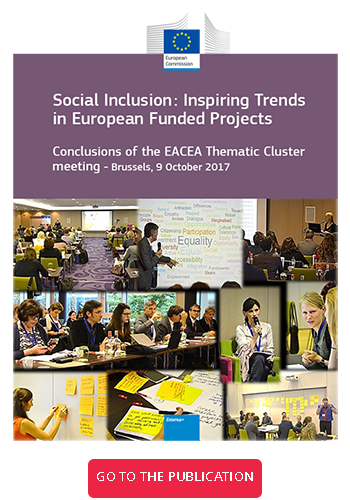
]]>It was the first event to involve projects from across three different EU funded programmes Erasmus+, Creative Europe and Europe for Citizens.
The meeting, aimed to collect and exchange project experience from grassroots organisations and identify ideas for better policy and programme design.
This seems part of a new trend with the EACEA (Education Audiovisual and Culture Executive Agency), to actually begin to consult with those who work on the ground and whose direct experience is vital for current programmes to become more relevant to actual lived lives.
Voices of Culture, led by The Goethe Institute is also working in a similar consultative way and will be
publishing the results of a structured dialogue process about Social Inclusion this Autumn.
L'articolo Social Inclusion: Inspiring Trends in European Funded Projects. proviene da Get Close To Opera.
]]>L'articolo Touching Home – A new sensory theatre show about London migrants proviene da Get Close To Opera.
]]>Imagine how it feels like to leave your country, to abandon everything that connects you to home to find a new home. And if you couldn’t use words, how would you express it?
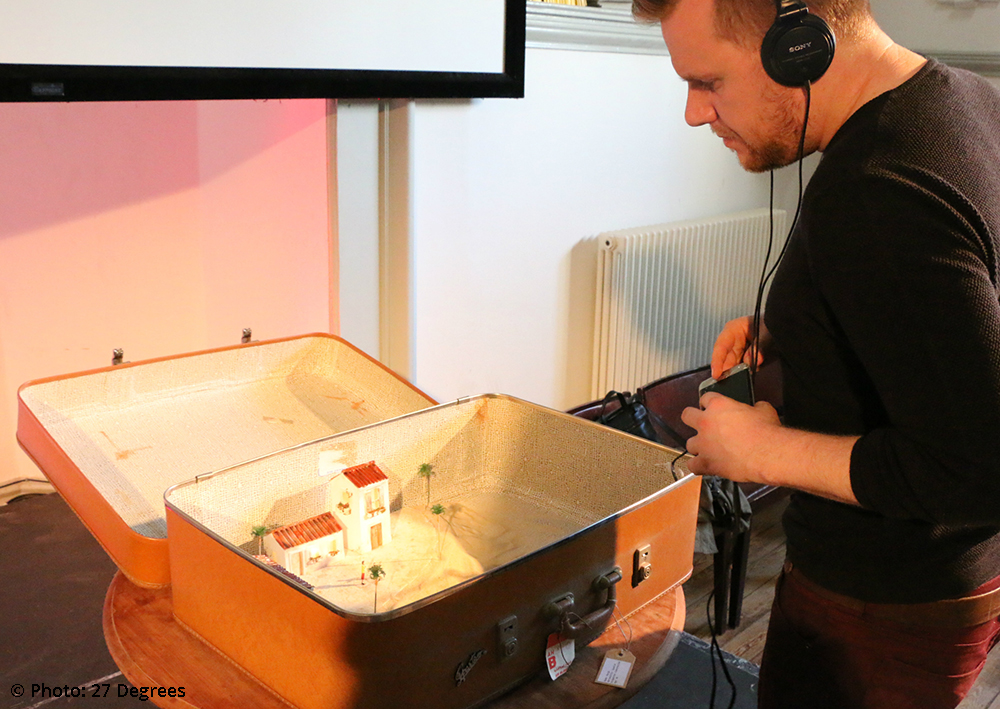
27 Degrees is developing a new sensory theatre show inspired by the everyday stories of London migrants, Touching Home. Walking away from the dramatic recollection of narratives shared by the media, the company wants to explore the intimacy of the experience of leaving one’s country and to use the senses to break the boundaries between audiences, performers and migrants.
The company was founded in April 2017 by Marie Klimis, Chusi Amoros and Dajana Trtanj, around a shared passion for immersive theatre and storytelling. 27 Degrees define themselves as a multicultural collective of artists: the lead artists are from Peru, Belgium and Croatia and they also collaborated with artists from Denmark, South Korea, Mexico, Poland and the UK. They specialise in multidisciplinary shows presenting international narratives that are universal and relevant in our global contemporary context. They started working on Touching Home in March 2018 with a three-month Research and Development (R&D) period supported by Arts Council England.
The first stage of the project was about collecting stories. One of the goals of the project was to showcase the diversity of London migrants: for this the artists interviewed 20 Londoners from a range of ages, occupations, backgrounds and origins, including people who migrated from India, Nigeria, Poland, Pakistan, Italy, Peru, Canada, Lebanon, Spain, Bosnia or the US, to name but a few. The questionnaire was centred on the concept of home and the sensory elements connected to people’s memories of migration.
The second stage of the R&D was a two-week residency at the Old Library in London, supported by Theatre Delicatessen. During the residency, the company invited guest practitioners to explore ways of sharing stories through sensory exploration: olfactory artist Sarah McCartney led a workshop on scents, showing how to create perfumes reminiscent of memories and how to practically use smells in performance; Anna Pearce explored the possibilities and challenges connected to touch; and Yaron Shyldkrot led a workshop on sound and darkness, used as tools to create comforting or unsettling environments.

This R&D led to new performance material combining original texts, sound or physical installations, dance, shadow puppetry, live cooking, olfactory storytelling or intimate audience interactions. Some scratch performances were then presented in June in London as part of Refugee Week and the Open Senses Festival. Now, the goal is to develop the show further in autumn and winter 2018, aiming to create a full immersive production in 2019.
In a world of political uncertainty, environmental challenges and increasing inequalities, there is a growing fear of the foreigner, the stranger, the unknown “them”. 27 Degrees want to make a show that celebrates the universality of the human condition, that tackles stereotypes about migration and explores empathy. Theatre scholars have shown over recent years that sensory exploration allows audiences to connect with narratives in a direct and affective manner. Smell, for instance, is the sense the most closely connected to memory in the human brain, and Helen Paris mentions its power to ‘cross geographical borders, celebrating what unifies us as humans’. And this is exactly what 27 Degrees are trying to achieve with Touching Home: the goal is not to tell migration stories to audiences, but for audiences to make these stories their own.
Further information: www.27degrees.org
Photos credit: 27 degrees
If you wish to share your experience with us, please write to info@getclosetoopera.com
L'articolo Touching Home – A new sensory theatre show about London migrants proviene da Get Close To Opera.
]]>L'articolo Macerata Opera Festival, Opera and Accessibility proviene da Get Close To Opera.
]]>Since 2008, Macerata Opera Festival opened up to accessibility with a project that is free and unique in Italy. As early as 2008, during the entire run of the Festival, the Audio Description Service is active for the benefit of visually impaired people.
The soirees with Audio Description are preceded by three tactile and themed routes, designed not only for visually impaired people but open to the whole audience.
Since 2009, Macerata Opera Festival has also offered the Subtitling Service in order to facilitate access of people with hearing loss to all planned performances. A service useful for the entire audience, actually.
Finally, since 2017, there has been two important news: all opera performances’ surtitles are also in English, and it’s possible to do a guide tour throughout the Opera House hiring a Italian sing language guide
How do you combine learning, art and social inclusion in your project?
Thanks to routes that suit everybody and the translations of Opera performances in different languages, we have made the Opera experience accessible to the whole audience. Moreover, we turned the Sferisterio (the ancient theatre in Macerata) into a place of and for everyone.
What was the project’s objective and how is it changed during the process?
Macerata Opera Festival opened up to accessibility services back in 2008, with the Audio Description Service for the Operas, but it grew up over time.
In 2016, in cooperation with the “Museo Tattile Statale Omero”, a tour between the arts and nature’s beauty of Marche Region (Italian Region) has been developed.
Then, the Surtitling Service, that has been active since 2009 in Italian language, was also offered in English language for a year.
Furthermore, since last year, Theatre and Opera itinerary in Italian sign language has been introduced.
The Festival has grown up in terms of services offered and in terms of audience: from 160 people in 2014, to 190 in 2015, 220 in 2016 and almost 300 in 2017.
Tell us a story, an anecdote, a particular moment related to the project
When the project designer and coordinator, Elena Di Giovanni, got me involved asking me to think a way to introduce people with hearing loss to Opera I immediately understood the importance of this assignment and I accepted the challenge. We don’t often have the opportunity to access cultural events, particularly in a complex and unusual context like the Opera.
There are many stories about the enthusiasm of people involved. Once a child said: “Thank you because today I find out a lot of beautiful things that I could have never imagined!”. Well, this was my gift for my work, a pure, simple and beautiful gift.
In my life I’ve chosen to give the opportunity to people to be touched, informed and enriched and this is what I am going to keep doing, tirelessly.
There are a lot of anecdotes about the tactile routes.
Here’s the feedback of a girl with visually disability, coming from Matera:
“At the end of my staying in Macerata when the curtain came down on Aida – in my opinion, the best performance of the Festival – I would like to thank the people that allowed me to go through an wonderful experience like Opera, at the same level as “normally sighted people.”
Starting from tonight, I will be able to tell everybody the story of Madama Butterfly, Aida and Turandot, thanks to the Audio Descriptions carried out in the best possible way by a superb team led by a determined professor, Elena Di Giovanni. She wanted to make the accessibility an asset and an added value of this Festival, because “Opera is for everyone”.
In a world less and less inclusive and frightfully populated by Leibnizian monads, I’ll bring with me the simplicity, expertise, kindness of all those incredible people I worked with during the Festival. Those people have allowed us to access Opera with more awareness.
During this music experience, I met some incredible people, that are like angels for me, thanks to whom we are more aware of the benefit of the Opera. I’ll take them with me in a world less and less inclusive, scarily inhabited
Thank you with all my heart, my new friend. You’ll remain in my heart.”
Opera and Sferisterio of and for everyone.
For more information on the project, visit the Website sferisterio.it
Credits
Macerata Opera Festival Accessibilità – Link: http://www.sferisterio.it/accessibilita
E-mail: arte.accessibile@unimc.it
Supervisor Macerata Opera Festival: Luciano Messi
Project coordinator: Elena Di Giovanni – Università degli Studi di Macerata
Surtitling Maestro: Daniele Gabrielli
Audio Descriptions and itineraries: Francesca Raffi
Accessibility Services: Chiara Pazzelli
Itineraries LIS: Consuelo Agnesi
Partner: Università degli Studi di Macerata, Unione Italiana Ciechi e Ipovedenti – Sezione Provinciale di Macerata, Museo Tattile Statale Omero (Ancona), Montclair State University (New Jersey, USA).
Tactile Itineraries are made in collaboration with Macerata Opera Festival workers and FORM (Orchestra Filarmonica Marchigiana).
Video and photo: Alia e Luna Simoncini
L'articolo Macerata Opera Festival, Opera and Accessibility proviene da Get Close To Opera.
]]>L'articolo Orfeo and Majnun. A community process to create a new Opera. proviene da Get Close To Opera.
]]>On 27th October our kick-off meeting in Brussels ended with the meeting with the Opera House La Monnaie / Du Munt. On that occasion we were made aware of a project called “Orfeo and Majnun”, a community process that aimed to create a new Opera inspired by the myth of Orpheus and Eurydice and the Persian love story of Layla and Majnun.
We thought to share this project with you because it has many elements in common with Get Close to Opera. It includes music, arts, theatre, Opera and different cultures.
The final result will be performed at the end of June at La Monnaie / Du Mont and it will be accompanied by a parade and several side events.
If you wish to share your experience with us, please write to info@getclosetoopera.com
Two intertwined stories
“Orfeo and Majnun” connects the ancient Greek myth of Orpheus and Eurydice with the Persian love story of Layla and Majnun.
For those who do not know, Orpheus was a famous poet and musician, an expert harp player capable of enchanting with his music and his poems. Orpheus was madly in love with Eurydice, but she died very soon. For this reason Orpheus decided to descend to Hades and bring back the beloved, thanks to the sound of his harp.
The deal made with Hades was clear: he could take Eurydice with him but he had not to look back while she was still in the dark and wait for Eurydice to get into the light before he looked at her. Orpheus broke the deal and lost his love forever.
Qays (Majnun) was also a poet madly in love with a woman: Layla. They, like Orpheus and Eurydice, didn’t have an easy life too. She was forced to marry another man and both Majnun and Layla died young.
The two stories are therefore stories of love, grief and longing.
A force called longing.
Indeed, an important source of inspiration for the Project is the longing.
The longing is not just an emotion in the hearts of lovers, but also a powerful energy capable of leading Orpheus towards Eurydice, making Majnun crazy, upsetting animals and mythical creatures, or looking for peace and beauty.
Longing is something everyone experiences every day, no matter who we are, where we come from and what we desire.
Longing is an universal sentiment, that enable us to research a better place.
“Longing is something everyone experiences every day: when we think of love or a lost love, of times past or a better future, of returning home or finding a better place to live.
We long for a peaceful community and a meaningful life – and we express those longings in music, words, and a wide variety of other artistic forms.”
(from La Monnaie / Du Mont Website)
Workshops and performances
The Project “Orfeo and Majnun” involved the community with workshops, through which each member participated in the way he/she preferred, living moments of joy and art, but also learning new skills from different Opera specialists.
An experience of cultural development, meeting of new people and beauty.
The first workshop was held in Brussels in September 2017, the second in February 2018.
The next appointment is scheduled for the end of June, when we are going to attend the final performance of the Project.
It will include:
- a big production in La Monnaie’s main auditorium, where around the two tales the community will weave a beautiful tapestry of different cultural influences, languages, and musical styles ;
- a big public social gathering in the streets of central Brussels. An open-air parade where animals and mythical creatures (made during the workshops) will lead us to the discovery of the stories dreamed up during the workshops.
Behind the scenes of “Orfeo and Majnun”
The project was designed and led by La Monnaie Opera House in cooperation with the Wiener Konzerthaus (Austria), the Festival d’Aix-en-Provence (France), the Valletta 2018 Foundation (Malta), Operadagen Rotterdam (the Netherlands), the Krakow Festival Office (Poland), and the MSMFeira (Portugal).
“Orfeo & Majnun” was also selected for funding by the European Union’s ‘Creative Europe’ programme.
For more information on the project, visit La Monnaie / Du Mont Website
L'articolo Orfeo and Majnun. A community process to create a new Opera. proviene da Get Close To Opera.
]]>L'articolo Music as an opportunity for social inclusion of refugees: El Sistema Greece proviene da Get Close To Opera.
]]>El Sistema Greece is a community music project inspired by the philosophy and methodology of El Sistema in Venezuela, founded in 1975 by the Venezuelan teacher and musician José Antonio Abreu. Music education has been proven to be an incredibly effective medium for achieving long-term social change for both the children involved and their families worldwide. El Sistema Greece’s ultimate goal is to promote the social inclusion of children refugees in Greek / European society through music that becomes a platform for dialogue and unity among different communities.
In 2015 more than a million refugees reached Greece in search of a better life on the European continent. This, alongside the financial crisis, created a humanitarian challenge for the country.
Cultural organizations have committed themselves to play an important role by creating creative spaces and projects to limit discrimination and prejudice against refugees. Arts forms such as painting, theatre, dance, music, photography and cinema have been the connecting vehicle between the new life and the traditions of their country of origin. Artistic expression becomes a therapeutic process for those who face the trauma of exile and promote self-esteem, emotional intelligence and well-being.
El Sistema Greece provides daily musical activities led by Greek and foreign teachers who volunteer in refugee camps, professional musicians and internationally renowned artists.
There are several positive impacts of the project:
– ARTISTIC INSPIRATION: working together to make a concert and make art together, give your talent to an audience, share an artistic inspiration. This will give perspectives and incentives to those children who find themselves in a difficult situation in the camps.
– SOCIAL INCLUSION: through the connection with Athens and other Conservatories and Western organizations, children will also have the opportunity to meet and share experiences with people who do not live in the camps. This will facilitate the integration of migrants in Western communities.
– POSITIVE AWARENESS OF FIELDS: give a positive view of refugee camps. The project, combining both migrants and Westerners, also reduces this gap / barrier that is created between migrants and the rest of the world.
Children refugees also find an educational program designed to develop memory skills, develop language skills, learn music, work in a team, face public performances without fear, defend traditional folk repertoires and develop new ones.
The memory and execution of the traditional popular repertoire from the refugee countries is an essential component of El Sistema Grecia.
For more information on the project, visit www.elsistemagreece.com
If you wish to share your experience with us, please write to info@getclosetoopera.com
L'articolo Music as an opportunity for social inclusion of refugees: El Sistema Greece proviene da Get Close To Opera.
]]>L'articolo The Complete Freedom of Truth International Youth Arts proviene da Get Close To Opera.
]]>TCFT grew out of the work of Opera Circus and began under the guidance of Nigel Osborne
in Bosnia and Herzegovina in 2004 and ongoing work in Srebrenica, BiH since 2008.
Founded and led by Tina Ellen Lee, Artistic Director, this continuous development process creates an inclusive creative space where young people and artists work together to explore diversity, gender, human rights, equality and understanding of the other.
Countries in which the project has partnered to date include Italy, Portugal, Serbia, Bosnia, Romania, Georgia and the UK.
How do you combine learning, art and social inclusion in your project?
By combining trust, truth, kindness, respect and tolerance as the basis for the work we want to achieve and the world we want to live in.
Our societies are made up of different cultures, races, abilities and languages and our projects work hard to reflect that. Sometimes it’s not easy and we have a long way to go to make work totally accessible to all
but this is our goal.
What was the project’s objective and how is it changed during the process?
The project is an on going long term process which develops through work experience, listening and learning.
The objective is to provide creative learning for young people and to challenge our current education system and society which doesn’t provide well rounded and inclusive education for work and life.
Tell us a story, an anecdote, a particular moment related to the project
Rather than tell a story here is a thought from one young person who has been involved in TCFT since
2014.
“Projects like TCFT are rare, it takes everyone to a place that is slightly outside the comfort zone and we are experiencing it all with people we don’t meet in our ordinary lives, it stretches us in a great way, we are more curious and we learn more.
Often disabled people and non disabled people don’t get to share important experiences like travelling together because we are taught through experience that we have to live separate lives; separate schools, separate seats in the theatre, separate train carriages… This project has given back to us the lost time and it allows us to re-evaluate how we want the world to look and how we engage with people in our local communities.”
Eilis 26 2017
Find out more about this project on Opera Circus Website.
If you wish to share your experience with us, please write to info@getclosetoopera.com
L'articolo The Complete Freedom of Truth International Youth Arts proviene da Get Close To Opera.
]]>