L'articolo How to develop a participatory intercultural project? proviene da Get Close To Opera.
]]>How to develop a participatory intercultural project?
In recent times our societies have become more culturally diverse, more complex and full of multiple challenges, creating a necessity for cultural collaborations focusing on intercultural dialogue, social inclusion and cohesion at local, national, regional and global levels. Participatory opera offers a great way to achieve this kind of collaboration as it brings together music, drama, design, story and song, and has traditionally embraced many different cultures.
However, intercultural collaborations and participatory projects are complex to create. Projects take place in many different contexts with a range of personalities and partners, and balance human, economic, artistic and educational resources. Finding the right vision for the project and persuading new partners that opera is the right approach can be a daunting task.
As part of the Get Close to Opera project, between January and March 2018 RESEO interviewed a range of its members (individual opera educators and opera houses) based in different EU countries. The interview explored their existing experience of designing and delivering educational activities involving the social inclusion of participants from disadvantaged backgrounds, particularly migrants and refugees. It also explored their and future training and development needs in this area. Although the process of participatory arts is widely established amongst many practitioners and organisations, the interview findings showed that approaches to participatory arts change depending on the differing local needs. The findings also showed that respondents were keen to share knowledge and practical examples of participatory work and that they would value the chance to look at real case studies.
As part of the Get Close to Opera Training, RESEO will offer a training module at the end of February 2019 in Matera, Italy, that will allow participants to share good practices from opera education programmes across Europe and develop a better understanding of what constitutes quality in participatory work. Participants will also explore new artistic and aesthetic approaches in intercultural participatory projects.
RESEO will offer case studies from members, introducing participants to a range of approaches and methods in participatory intercultural work. The session will explore the differences between projects, identifying their strengths and weaknesses and discuss the challenges of setting up opera/artistic educational projects and productions. Selected case studies will represent recent opera educational projects and productions addressing the topic of social inclusion and social cohesion through the participatory approach. Participants will also discuss ways of encouraging participation of diverse groups and audiences, as well as look at what qualities, skills and knowledge are necessary to develop participatory intercultural projects.
The pilot module is aimed primarily at creative practitioners, opera and art educators, and artists who seek to lead or engage in intercultural artistic projects, and/or projects that intersect with aspects such as class, race, culture, nationality, religion. Participate in the #GCTO Training Week!
ABOUT RESEO
RESEO is a network for arts education and creative learning with a specific focus on opera, music and dance. Founded in 1996, RESEO brings together organisations and artists from Europe and beyond to promote innovation and equal access to creativity, exchange ideas, and collaborate on shared initiatives, making us a true catalyst for development in the field. RESEO also works with a range of partners to advocate for the value of opera, music and dance education.
Photo Credit: Sybilla Britani
L'articolo How to develop a participatory intercultural project? proviene da Get Close To Opera.
]]>L'articolo Planning your creative educational project: why and how? proviene da Get Close To Opera.
]]>Why? Because planning…
- gives perspective
- gives directions
- helps identify goals
- uncovers problems
How? In our “Your educational project: Goal, Plan, Action!” module, you will be introduced and test yourself the Creative Project Canvas.
This reflection tool will help you map and plan different ideas for work, projects and programmes, stimulate your thinking about the different aspects of your project and visualise how your ideas might connect with people that might want to see, engage or participate in your work.
The Creative project Canvas will help you plan your creative educational project by exploring…
- its VALUE to yourself and other communities and how you obtain the benefit of providing that value.
- the benefits of BELONGING TO NETWORKS you are currently part of or you might join that can provide you with contacts and resources to create, develop, produce and promote your project.
- the ACTIVITIES AND WORK of your project e.g. research, preparation, production, marketing, touring, workshops, reviewing.
- the EQUIPMENT, MATERIALS AND TIME that it requires and the time for each process giving the whole time requirement.
- who can be CHAMPIONS AND CRITICS of your project, i.e. those who can serve you as a guide and champion or improve aspects of your work as a critic and therefore help you to develop and strengthen your own artistic/creative voice.
- ways of ACCESS FOR OTHERS, i.e. how local and other communities can access your work.
- ways of GETTING FEEDBACK, i.e. current and potential tools and methods to get feedback about your work/project from everyone who gets or might get involved with it.
- its SHORT TERM GAINS AND LOSSES as well as LONG TERM REWARDS.
The initial idea spurring the development of an education project may have come from a variety of places, ideas, needs and personal beliefs. In the enthusiasm and excitement of the moment, however, it often happens that not all projects are timely or appropriate.
The major success of an educational project lies in critically examining the viability of an idea, analising, visualising and implementing its measurable, achievable and time-bound goals. That is why project development requires a commitment to a systematic, iterative process of assessment, design, implementation and evaluation, as it is a cyclical process in which the results of one phase become the starting products for the next phase.
The purpose of educational planning is to ensure the systematic accomplishment of a series of activities leading toward the achievement of set objectives of educational development.
All envisaged practical activities and strategies that Materahub will carry out and deliver during the training session for “Your educational project: Goal, Plan, Action!” module aim at guiding learners through the main steps of action needed to design an exciting and educational experience:
- What are the activities to be undertaken?
- Who will undertake them?
- What resources will they consume?
- What targets will they accomplish?
- How will the success of these activities be evaluated?
The process of working out detailed answers for these questions so as to help implement the plan is the actual completion and elaboration of the innovative strategic visual framework Creative Project Canvas, which, just like an artist’s canvas, is a place to turn your educational project and creative inspiration into reality and share it with your team, audience and learners.
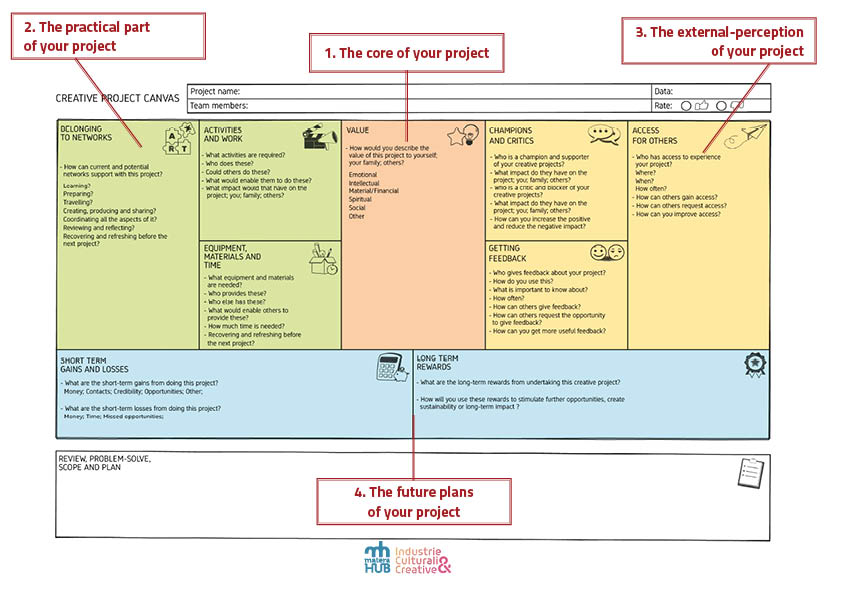
The Creative Project Canvas is a strategic visual framework and reflection tool made up of 9 themes including questions to help you clarify and reflect on your creative educational project. By answering them, you will be able to outline the key steps in your educational projects planning process: set project goal/s, evaluate time and resources available, design methods to get feedback and review. The central part of the Creative Project Canvas is the CORE of your project, the left part is the practical part of your project, the right part is the external perception of your project and the bottom part is the plans of your project.
Get Close to Opera is going to run a training week in February 2019 about Opera through #multipleintelligences #womenrights #disabilities and #immigrantinclusion. It will take place in the beautiful UNESCO city of Matera, in the south of Italy, that will be the European Capital of Culture in 2019.
The module developed by Materahub (Italy) will be “Your educational project: Goal, Plan, Action!”.
If you work in the field of Opera Education, participate in the #GCTO Training Week!
L'articolo Planning your creative educational project: why and how? proviene da Get Close To Opera.
]]>L'articolo Forming, storming, norming and performing. A reflective evaluation tool for teams proviene da Get Close To Opera.
]]>Today, ESART (Spain), that is developing two modules for the GCTO Training Eeek, introduces us the idea of the “value of journey” of the psychologist Bruce Tuckman.
If you are interested in this training module, participate in the #GCTO Training Week!
Forming, storming, norming and performing.
A reflective evaluation tool for teams.
As every dedicated traveller learns, the really interesting and valuable part of getting somewhere is very often the journey itself as opposed to arriving at the actual destination. Those “along the way” experiences come together to inform future travel decisions. In 1965, psychologist Bruce Tuckman seized upon this basic idea of the “value of the journey” to apply to and examine how teams work and how the information gathered as they worked towards a goal could be structured, reflected upon, recycled and employed to improve effectiveness in future team efforts and team leadership. In an article Tuckman wrote titled “Developmental Sequence in Small Groups” (Tuckman, 1965) he outlined a theory that examined what he considered to be the four phases that many teams experienced as they followed their journey to defined endpoint. He denominated those four phases as: Forming, storming, forming and performing. A subsequently added fifth phase , adjourning, recognises that some teams may only enjoy one or few journeys together and will not be recycling the acquired knowledge or camaraderie within the same team. This is increasingly common as project-centred work that brings together defined skills for a specific project or projects is more prevalent.
As Tuckman postulated, the individual phases consisted of:
Forming
This is the “get to know each other” phase where individual team members settle into their place in the group and evaluate their profile as it compares to that of others including strengths, weaknesses, leadership ability, unique skills and an assessment of where they fit into the group dynamic and hierarchy. This is a phase that can take some time to come together and may require strong facilitation skills to bring the group purpose into focus.
Storming
As team members become more confident with their place in the group they, consequently, become more secure in their capability to act and challenge the boundaries established during the Forming stage. In this process with individual group members flexing their muscles conflicts can easily emerge. This often coincides with early-stage project development activities where roles and relationships may not have been clearly articulated or goals and their value are not yet totally defined and embraced by the team. The resulting turbulence could occur between team members or, as a challenge to authority, between members and team leadership.
Norming
This is the part of the journey where the captain (project leader) announces that the turbulence has subsided and you can unbuckle your seat belt and enjoy some smoother flying. Conflicts generated during the Storming phase have worked themselves out, team relationships are stronger and even more cordial and alignment with team goals has come into general focus bringing with it tangible progress toward achieving the goals. This phase may make a positive contribution towards validating the merits of the project leadership.
Performing
This is the project delivery phase where the successful work of the previous phases, having created the requisite organisational foundation, structures and processes, is brought to fruition through efficient and effective team working. The cohesiveness of the team has made it ready for new work, new members and, if leadership is confident and inspired, individual growth through delegation and development.
Adjourning
Teams will very likely have a finite lifetime lasting anywhere from one project to on-going collaboration over many years. Adjourning recognises that fact that, as the song goes, “Breaking Up is Hard to Do” and members and leaders who value stability and predictability may need to develop individual abilities to help them facilitate transition from and to other teams.
The Tuckman theory has proven value as a reflective and team building tool in a range of settings where projects and the associated teamwork are the basis of goal implementation. Reflection (team and individual) leads to Action Plans which lead to improvement of team working. Application of the Tuckman theory could take place in industry, education, social work or the performing arts, among other areas. It has been of demonstrated value at a number of levels to team members, teams and team leaders who need a structured methodology to frame their reflective processes. It is a methodology that provides a useful complement to other reflective tools such as: SWOT, Meyers Briggs, Belbin Team Roles, Kolb Learning Styles and others.
Resources
Tuckman, B. W. (1965). Developmental sequence in small groups. Psychological Bulletin, 63(6), 384-399.
L'articolo Forming, storming, norming and performing. A reflective evaluation tool for teams proviene da Get Close To Opera.
]]>L'articolo Opera as a medium that includes all intelligences proviene da Get Close To Opera.
]]>A proposal for Arts Educators
If you daily work with Opera and Arts in schools, in theatres, in academies, you probably know how complex is the process of guiding the learning path, of inspiring people in order to boost their creativity, of negotiating rules in order to reach a creative goal. As everyone has their own way to learn, it could be very difficult for an educator to guide a group without considering the wide variety of intelligences within it. But how can you identify and include them in an opera and arts training session?
We are going to propose a method that uses Opera as a peculiar medium to bring out all the intelligences in a group.
We’ve already discussed about the multiple intelligences Theory in the article “Learning how to learn. Multiple intelligences at work”.
Now, we want to put them into practice through Opera. Why?
Opera is a multiple medium that can suit all kind of learners because it has got in itself elements that could catch the interest of everybody. For example, the libretto can be considered the entry point for people with a predominant linguistic intelligence; the score for those with a predominant music intelligence, the scenography and choreography for those who are visual and body smart. The inter- and intra-personal intelligences can find their place analysing, for example, the inner-life of the protagonist or his behaviour and relationship with the antagonist. Even the logical and the naturalistic intelligences can be included in the Opera.
All of this has to be considered in an harmonic way, because everybody has a unique combination of all these intelligences, that makes everyone a special human being.
During the Training Week in Matera, we are going to identify with the participants the predominant intelligences in the group through some practical activities and open a group discussion in order to deeper understand them.
In the second part we are going to co-design the GCTO boxes. They are boxes for each intelligence full of inspiring objects related to Opera that could guide participants through the creative and learning process. It will be an open source tool that every participants could experiment in their own training sessions.
If you are interested in this topic, participate in the #GCTO Training Week!
ABOUT L’ALBERO THEATRE COMPANY
Vania Cauzillo: theatre and art director, documentarist. She runs the L’albero theatre school, and a festival of scientific dissemination. She also deals with arts education and audience development.
Mariateresa Paolicelli: English teacher, Game-based learning & Multiple Intelligences consultant.
Find out more about http://www.lalbero.org
L'articolo Opera as a medium that includes all intelligences proviene da Get Close To Opera.
]]>L'articolo The role of an intercultural mediator proviene da Get Close To Opera.
]]>Today, Eugenia Arvanitis & Spyridoula Giaki, from University of Patras, introduce the training module that they are developing dedicated to the role of an intercultural mediator.
If you are interested in attending this training module, participate in the #GCTO Training Week!
The role of an intercultural mediator
Mediation process is a unique convergence that can (re)shape participants’ lifeworlds, namely values, beliefs and principles forming new social spaces of engagement through reciprocal communication and understanding. In this context, mediators assist parties from different cultural contexts to understand one another by becoming aware of (own) biases towards processes, persons, behaviors and outcomes and to engage in effective communication and action (Arvanitis, 2014; Sani, 2015).
Modern mobility affects societies both structurally and culturally. It challenges social cohesion and national identity building. However, cultural identities are highly shaped by diversity. Modern citizens and non-citizens sooner or later enter into an act of reconstructing national and cultural identity where local perspectives and otherness ought to be considered (Baraldi & Rossi, 2011). The important point here is to enable interlocutors to use their communication and mediation skills so to interact with each other in an open, reciprocal, inclusive and self-reflexive way. Intercultural dialogue and mediation can build a balanced relationship between parties of different cultures and a new social space where cultural transformation may occur.
An intercultural mediator (also called ‘community interpreter’) facilitates communication between domestic, ethnic and migrant individuals, families and communities in general (Catarci, 2016). The role of intercultural mediators is both to support migrants and refugees to settle in the new country and to liaise with social actors and institutions so to understand migrant settlement needs and communicate with respect to their diversity (Cohen-Emerique, 2007:8). Acting as an intermediate between refugees/migrants and the society, intercultural mediator tackles cultural and language barriers and fosters inclusion and the development of a culture of openness. Intercultural mediator deals with beneficiaries and assists them to deal with the complexities of social citizenship. It facilitates refugee/migrant needs and collaborates with public servants in supporting them to design, implement and evaluate of social and civic interventions (Cartaci, 2016). In general, intercultural mediation is considered as a “systemic response to secure access to public services” (Arvanitis, 2014:1).
In the school context, the role of intercultural mediator is becoming more and more necessary, as educators deal with learners from diverse backgrounds. When someone addresses a diverse school ecology in real situations then it becomes more aware that mediation is necessary. The coexistence of refugee children and teenagers, diverse families, teachers and the other actors or the native population create a complicated sociality that needs to be mediated so that all school community partners can both express and accept cultural diversity (Baraldi & Rossi, 2011). Educators act as intercultural mediators. They have the task to create an inclusive learning environment where both migrant and native children have the right of self-expression and at the same time the obligation to respect different cultural identities and promote successful communication/collaboration across cultures. Intercultural mediation tries to teach dialogue among cultures, creating the conditions for both maintenance and mutual enrichment of cultural identities. An intercultural educator should promote agency and active participation for all children in multicultural classrooms (Nairnby et al, 2003). Intercultural mediator’s role is to support newly arrived refugees/migrants and to familiarize them with the school context and culture. But also, to work effectively with all students (natives and others) to identify and combat stereotypes from both sides. Establishing a culture of mediation at school level can develop educator’s empathy not only on refugee/migrant students’ personal life experiences (Sani, 2015) but on the whole student population.
Efficient intercultural mediators are those who possess certain skills and attitudes. Such as good migrant language skills, both spoken and written (Sani, 2015). Also, an efficient mediator has a solid knowledge of both the migration population and the mainstream culture, ensuring that refugees/migrants have the right and space to express their needs and that mainstream society understands the situation and handles it properly. Another essential skill is a good grasp of the social context and of all the regulatory aspects related to mainstream healthcare, national social service, education, work, etc. In relation to the above, intercultural mediator must be able to foresee the possible conflicts that could arise from the encounter of different cultures and traditions. Thus, management skills and handling obstacles to the integration and access to education and medical care is required (Sani, 2015).
The above skills can be summarized to the model of intercultural competence that is used to look for evidence of specific attitudes, skills and knowledge that shape an intercultural speaker (Byram, 1997:58-64).
In brief, the model of intercultural competence consists of five elements with the first two functioning as preconditions for successful intercultural/interlingual interaction and the rest as necessary skills:
• attitudes: relativise self and value other; suspend belief in own and disbelief in other’s behaviours, beliefs and values
• knowledge: of own and other’s behaviours, beliefs and values; of how each is seen by other – comparative methods.
• of interpreting and relating ‘documents’/‘texts’ based on existing knowledge and attitudes
• of discovering (in own time or in interaction) new behaviours, beliefs and values
• of interacting in real time based on other preconditions and skills
• the responsibility of the teacher to develop ‘critical cultural awareness’ (Byram, 1997:58).
To sum up, personal disposition and respect are primarily important in establishing effective social relationships. Intercultural mediators support both refugees/ migrants and native population to understand their differences from an interpersonal and an intercultural perspective and collaborate towards common goals.
Eugenia Arvanitis & Spyridoula Giaki
Resources
- Arvanitis, E. (2014). The intercultural mediation: a transformative journey of learning and reflexivity. In E. Arvanitis & A. Kameas (Eds), Intercultural mediation in Europe: narratives of professional transformation (pp. 1-16). USA: Common Ground.
- Byram, M. (1997) Teaching and Assessing Intercultural Communicative Competence. Clevedon: Multilingual Matters.
- Catarci, M. (2016). Intercultural Mediation as a strategy to facilitate relations between the School and Immigrant Families. Revista Electrónica Interuniversitaria de Formación del Profesorado, 19(1), 127-140.
- Baraldi, C. & Farini, F. (2013). Trust and Facilitation in Educational Interactions. Participation, Citizenship and Trust in Children’s Lives, 132-153.
- Nairnby, K., Warren, J. & Bollinger, C. (2003). Articulating contact in the classroom: Towards a constitutive focus in critical pedagogy. Language and Intercultural Communication, 3(3): 198–212.
- Sani, S. (2015). The Profession and the Roles of the Intercultural Mediator in Italy. Procedia – Social and Behavioral Sciences. 191. 2546-2548.
L'articolo The role of an intercultural mediator proviene da Get Close To Opera.
]]>L'articolo Access and Inclusion: Getting the Balance Right proviene da Get Close To Opera.
]]>The initial period of research for GCTO described in our previous short article, raised many questions about inclusion in communities and how informal arts education can contribute to the creation of a more cohesive and just society.
In this next stage of this GCTO process, we are going to look at a first step training module to explore the question of how to build an inclusive arts educational activity or workshop.
During the research period we interviewed in depth 14 experienced artist/ facilitators and Heads of Outreach Participation and Educational Departments in major opera companies in the UK. These conversations have helped us understand just a small proportion of the widespread informal arts educational work that takes place in England, Wales and Scotland.
People described the many challenges that they faced in this field and that much work needed to be done in order to develop programmes that reflect and respect those cultures with which we all need to engage.
Through discussions and exercises, we will examine why it is important to build a process with the participants of an informal arts programme from the beginning. It will offer tips where to go for advice and help with how to design your training, workshop or activity so that it is not an imposition of ideas but an organic process where the “beneficiaries” are the “organisers”.
By the end of the training session we hope participants will have an increased understanding of the issues of social inclusion and accessibility and some tools to incorporate into inclusive practice in their own activities.
This will be a sharing as much as a training session and learning from our participants experiences is as important to our process as delivering our own experiences.
We look forward to working with our participants and trainers in Matera in February 2019. Participate in the #GCTO Training Week!
About Opera Circus
Tina Ellen Lee, the Artistic Director of Opera Circus, one of the partner companies of GCTO, has recently been working with Voices of Culture on a Structured Dialogue process about Social Inclusion, supported by the European Commission and The Goethe Institute. Thirty five cross sector civil society organisations participated and the resulting document will be published later this year and shared widely. As a co-founder of Opera Circus, Tina has been a performer, artistic director and producer for the company since its inception. Tina is a Project Manager for Opera Circus with GCTO.
Foteini Galanopoulou, Project Assistant for GCTO for Opera Circus. Foteini’s portfolio has been built primarily through working with and supporting disabled artists in their practice or disabled-led art companies in their projects, consulting arts organisations on how to improve accessibility for their disabled audiences, artists and employees and broader project management work for UK and cross-European projects.
Find out more about Opera Circus: www.operacircusuk.com
PHOTO CREDIT
“Performance for The Complete Freedom of Truth UK.”
Part of a sharing of work at Bryanston School, Dorset, UK, during the pilot TCFT programme.
Find out more: http://thecompletefreedomoftruth.com
Photographer: Robert Golden
L'articolo Access and Inclusion: Getting the Balance Right proviene da Get Close To Opera.
]]>L'articolo Women’s Rights in Arts: Training for Art Educators proviene da Get Close To Opera.
]]>Get Close to Opera project, with its research phase, presents an elaborated overview of the training needs of opera/art educators, cultural mediators and artists who work with learners coming from different socio-cultural and ethnic backgrounds. Based on research results, each project partner focuses on different aspects of these needs. European Network of Migrant Women (ENoMW) has been committed to prepare a training module to provide opera/art educators and cultural mediators with a sustainable way to embed women’s rights perspective and intercultural competence into their teaching methodologies and practical activities.
The aim of the training module developed by ENoMW is to strengthen the knowledge and skills of educators and help them create a teaching framework prioritising women’s rights. Art educators, first of all, will be informed about basic concepts related to women’s rights and feminism, developed by the international women’s rights scholars and activists. Through a series of participatory exercises, trainers will explore how gender roles and expectations are socially constructed and how they intersect with other factors such as age, ethnicity, race, class, culture and religion. The main theme of this first part is to explore and explain the universal historic struggle for women’s rights and to tease out the problems that might arise in case art education lacks a women’s rights-based approach.
The training, furthermore, seeks to unite art education together with feminism in both philosophical and practical aspects. Historically a male-dominated field, art can be a tool in representing women as problematic, normalising violence against women, and reproducing gender biases against female artists and women in general. On the other hand, it can be a powerful mechanism to represent feminist perspective and women’s point of view about their bodies and personal experiences. It also can help us understand the power relationship between women and men, as well as among other groups, such as ethnic minorities/migrants and society’s majority. To exemplify this, participants will be provided with stories of women’s struggle and empowerment from around the world through the arts.
ENoMW will also address the difference between cultural relativism and (inter)cultural sensitivity to assist art educators in improving their knowledge about the importance of acknowledging the universality of human/women rights standards to fight against the challenges to women’s rights in every field, including art. Making such a differentiation is crucial for educators working with learners from different cultural and ethnic backgrounds. It helps educators not to confuse cultural relativism with cultural diversity and (inter)cultural sensitivity. The former rejects some aspects of universal human/women rights and supports subjectivity of moral actions depending on cultures in different societies, while the latter refers to the co-existence of difference in language, lifestyle, religion, ethnicity and traditions and recognition of these differences in society to maximise mutual communication and cohesion between different groups.
In addition, one phase of the training will specifically focus on informed consent since ENoMW believes that educators working with all women learners, including migrant, refuge and ethnic minority women, should base their methodology on the solid understanding of informed consent. Participants will be provided with the knowledge about the importance of giving learners space to explain their specific needs and express their feelings and understanding their personal stories and problems. This aspect of the training is specifically important for female participants in art sessions, as society often misconstrues women’s expressing their feelings as ‘deviant’ or ‘inauthentic’ and generally sanctions women speaking up publicly. Furthermore, the training will also refer to challenging and sensitive aspects of art education, including nudity and guide art educators to handle these situations.
The last part of the training will be based on understanding specific needs of migrant, refugee and ethnic minority women and girls. This part is substantial particularly for art educators working with women/girls from different ethnic backgrounds. Get Close to Opera research results show that educators might have problems about being familiar with needs and desires of their learners. Therefore, this training will examine multiple and overlapping factors -e.g. age, ethnicity, economic/legal/family status, sexual orientation, religious practice, experience of violence- shaping personal stories of ethnic minority women learners. ENoMW trainers will facilitate understanding of these traumatic experiences in different phases of migration. To be able to use art as a trauma therapy, art educators should be aware of the challenging history and continuing difficulties migrant/refugee women cope with. Then they can formalise a space where women/girls feel comfortable and enjoy the freedom to express themselves without the fear of judgement, away from stress and trauma.
ENoMW will wrap up the training session with a ‘to do- not to do list’ for art educators. The aim of the list is to summarise all important points addressed during training. Art educators, furthermore, can always go back to this list when they encounter challenges while working with migrant, refugee and ethnic minority women.
Sinem Yilmaz
Get Close to Opera is going to run a training week in February 2019 about Opera through #multipleintelligences #womenrights #disabilities and #immigrantinclusion. It will take place in the beautiful UNESCO city of Matera, in the south of Italy, that will be the European Capital of Culture in 2019. Participate in our Training Week!
L'articolo Women’s Rights in Arts: Training for Art Educators proviene da Get Close To Opera.
]]>L'articolo Dave gets close to Opera proviene da Get Close To Opera.
]]>Get Close to Opera is going to run a training week in February 2019 about Opera through #multipleintelligences #womenrights #disabilities and #immigrantinclusion. Today we introduce the module developed by ESART (Spain): “Get close to learning. Creating a virtuous circle of good practice.”
If you are interested in this training module, participate in the #GCTO Training Week
Dave gets close to Opera
The upcoming Get Close to Opera (GCTO) training sessions to be celebrated in Matera, Italy at the end of February 2019 promise to bring current and aspiring Opera and Arts educational practitioners together with a range of professional facilitators who will lead workshops and classes covering key aspects of the developing practical GCTO implementation methodology. The facilitators will lead a diverse assortment of sessions and workshops relevant to our proposal to deploy Opera and Arts educational activities strategically to facilitate the integration of migrants into European life, culture and society. Currently, the training modules are set to cover themes such as Multiple Intelligence Theory, Project Planning, Gender Equality, Access and Inclusion, Participatory Arts Education, Co-Creation, Cultural Mediation and Monitoring and Assessment.
Over the coming months leading up to to the Matera event there will be frequent updates on the activities to take place and what they will entail. So, as part of that on-going information stream, we start here with a look at the Monitoring and Assessment module. This session has been baptised as “Get Close to Learning” and its broad purpose is the provision to training facilitators of some basic evaluation guidelines capable of building their capacity in the design and implementation of effective evaluation tools that can contribute to an on-going cycle of improvement to good practice in teaching, facilitation and learning.
The tag line for the module is: Creating a virtuous circle of good practice. “
The session will include theoretical and interactive practical elements including:
- Design effective monitoring and data collection strategies and tools
- Employ appropriate qualitative and quantitative data analysis techniques.
- Create reports that are accessible to a range of users
- Draw conclusions that inform improvements in learning and delivery practices.
- Implement findings and continue with the virtuous circle.
These final two points provide the perfect opportunity for me to introduce you to Dave – maybe you know him already.
I am referring to David A. Kolb, the learning theorist who, in 1984, proposed his experiential learning theory. The model contains two broad elements that include a four stage learning cycle alongside a separate dimension that focuses upon four distinct learning styles.
The Kolb Learning Cycle looks like this:
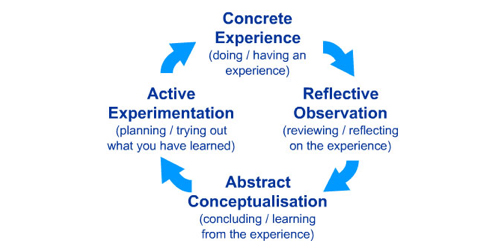
Kolb’s Learning Styles inventory contemplates four distinct approaches that individuals take to learning.
The individual styles are defined according to how a person understands and processes information. A short description of each style includes: [1]
Style Convergent
The convergent learning style relies primarily on the dominant learning abilities of abstract conceptualization and active experimentation. The greatest strength of this approach lies in problem solving, decision-making, and the practical application of ideas.
Style Divergent
The divergent learning style has the opposite learning strengths from the convergent. It emphasizes concrete experience and reflective observation. Its greatest strength lies in imaginative ability and awareness of meaning and values.
Style Assimilative
In assimilation, the dominant learning abilities are abstract conceptualization and reflective observation. The greatest strength of this orientation lies in inductive reasoning and the ability to create theoretical models, in assimilating disparate observations into an integrated explanation.
Style Accomodative
The accommodative learning style has the opposite strengths from assimilation, emphasizing concrete experience and active experimentation. The greatest strength of this orientation lies in doing things, in carrying out plans and tasks and getting involved in new experiences.
The Kolb theories are relevant to a variety of the GCTO work as the Learning Cycle provides an understanding of and, indeed, a framework for structrured reflective practice that can lead to the creation of a virtuous circle of good practice in both delivery and evaluation.
Learning styles describe how each person learns and not what they actually learn. While everyone will possess a dominant style no one style is inherently better than another. Awareness of own and others’ styles with respect to working and evaluation processes, an awareness of the mix of styles in a group c is key. This can represent an important factor when deciding upon course contents, delivery method, communications channels and, bringing things back to assessment, the design of effective monitoring and evaluation tools that resonate with the group.
We’ll discuss more about the Kolb theories and their relevance and application to our GCTO work in a future submission. If you want to delve deeper into Kolb’s theories the internet abounds in papers, You Tube Videos and other information. To get a sense of your own Kolb-defined learning style you can take a test available online at:http://www.bunbury.wa.gov.au
[1] Kolb, D. (1984). Experiential learning: Experience as the source of learning and development. Englewood Cliffs, NJ: Prentice-Hall.
L'articolo Dave gets close to Opera proviene da Get Close To Opera.
]]>L'articolo Learning how to learn. Multiple Intelligences at work. proviene da Get Close To Opera.
]]>It will take place in the beautiful UNESCO city of Matera, in the south of Italy, that will be the European Capital of Culture in 2019.
L’Albero is developing a training module that would guide the Opera and Arts Educators to create differentiated learning strategies based on Multiple Intelligences.
If you are interested in this training module, participate in #GCTO Training Week!
Learning how to learn. Multiple Intelligences at work.
One Intelligence Versus Multiple Intelligences
Learning is a complex process that occurs, not only in educational contexts, but also in professional work environments, throughout cultural experiences, and daily life. Therefore, learning is a continuous process of our life. Becoming aware of how it works, can help us to feel able to potentially learn anything.
Moreover, the learning process differs from person to person. In the 80s, Howard Gardner, a Harvard Psychologist, demonstrated the existence of a range of intelligences, challenging the common belief that there was only one intelligence.
He developed the theory of Multiple Intelligences to provide a cognitive model that sought to describe how individuals use their intelligences to solve problems.
Initially, he described seven intelligences (H. Gardner, 1983). Then, he added an eighth and discussed the possibility of a ninth (H. Gardner, 1999). They are the linguistic, logical-mathematical, visual-spatial, musical, bodily-kinesthetic, interpersonal, intrapersonal, naturalistic, and existential intelligences.
“We are all able to know the world through language, logical-mathematical analysis, spatial representation, musical thinking, the use of the body to solve problems or to make things, an understanding of other individuals and an understanding of ourselves. Where individuals differ is in the strength of these intelligences and the ways in which such intelligences are invoked and combined to carry out different tasks, solve diverse problems and progress in various domains.” Hani Morgan (2014)
According to Gardner, the diversity of learning styles should impact the way people are educated. It is not possible that everybody learns the same things in the same way. Multiple Intelligences provide eight different potential pathways to learning that can be used as a mediator, to differentiate how students access the contents. When educators learn how to differentiate contents, the probability, that most learners would be included in the learning experience, rises. An inclusive context promotes a positive emotional environment for learners, thus enhancing their emotional development by making them feel comfortable, happy and more confident. This, allows learners to take risks and achieve their full potential (Leatherman & Niemeyer, 2005).
Differentiating not only ensure all learners to feel they are able to accomplish the same tasks, but they also become aware that in a group diversity means complementarity.
Since Get Get close to Opera Project’s research showed the need of increasing the knowledge about learning processes among Arts educators, L’Albero Theatre Company has designed a training that would guide them to create differentiated strategies based on Multiple Intelligences. Opera would become the background where all eight intelligences are represented.
Mariateresa Paolicelli
L'articolo Learning how to learn. Multiple Intelligences at work. proviene da Get Close To Opera.
]]>L'articolo Women’s Rights and Equality in Art Education proviene da Get Close To Opera.
]]>It will take place in the beautiful UNESCO city of Matera, in the south of Italy, that will be the European Capital of Culture in 2019.
Today, European Network of Migrant Women introduces the thought and the principles at the heart of its training module: “Women’s Rights and Equality in Art Education”.
If you work in the field of Opera or Arts Education, participate in the #GCTO Training Week
Women’s Rights and Equality in Art Education
Underrepresentation of women in artistic fields has always been a question for feminists, women artists and art historians. Art history depicts various challenges women deal with while producing art in previous eras. It is clear that stereotypical gender roles, social and economic barriers have always held women back. Power imbalances women encounter in different fields have also affected their individual choices to be involved in art activities. In A Room of One’s Own, Virginia Woolf describes women’s difficulties in producing creative works at her times:
“…fiction is like a spider’s web, attached ever so lightly perhaps, but still attached to life at all four corners… these webs are not spun in mid-air by incorporeal creatures, but are the work of suffering human beings, and are attached to grossly material things, like health and money and the houses we live in”.
Having independence and the income essential to follow a career as an artist were not always enough, because most women still found it hard to be accepted to art academies and institutions due to ‘morality’ concerns of these institutions.
The lack of visibility of successful women artists goes hand in hand with the representation of women in artistic works as, on the one hand, ‘infidel’, ‘immoral’, and as such deserving to be punished by men, and, on the other, objects, most frequently sexual, without personal agency, desire or will. In the art history women were mostly present as models, instrumentalised and misinterpreted by men. Women’s body was portrayed as pure and beautiful by and for the male gaze and that shaped ideal female beauty. Reproduction of gender roles and norms is indispensable with such representations. In short, the works produced by female artists were always neglected, while the majority of the nudes in art were female.
Despite this negative relationship between women and art in history, art is one of the most powerful tools in transmitting the message of feminist perspective by breaking down these stereotypes and creating equality. Art constructs and communicates identities along with changing the narrative. It can also introduce the world women’s point of view about their bodies and personal experiences. For these very reasons, raising awareness with regards to sex roles and corresponding gender constructs in society will help arts educators and practitioners to understand multiple challenges and inequalities women experience in different paths of their lives. Further to that, it is crucial to consider the intersection of these gender roles with ethnicity, race, class and religion and how it creates multiple disadvantages especially for migrant, refugee and ethnic minority women. This approach is important in understanding specific needs and challenges of these women and constructing teaching methodology regarding personal histories of learners.
Embedding this sensitivity will raise awareness about struggles of women in general, while at the same time it will provide art educators and practitioners with a sustainable way to embed both women’s rights and intercultural competence into their activities. By this way, art might help millions of migrant and refugee women to overcome traumas and hardships and rebuild their lives in European countries. These women can tell their stories and express their feelings through art, only if their needs are understood, and personal borders and boundaries are respected.
Get Close to Opera Project allowed us to recognise the role of opera and arts education in non-formal settings on the social inclusion of migrants and refugees. Through qualitative and quantitative research, we had the chance to explore training needs and challenges of arts educators in six European countries. Strikingly, we also found that training needs about women specific needs and gender equality were not emphasized by research participants. This finding highlights the significance of raising awareness with regards to women’s rights approach and further develop a framework about specific needs of (migrant/refugee) women for arts educators. Therefore, European Network of Migrant Women designs a training module to create a framework with a general set of principles guiding arts educators about the importance of embedding a feminist perspective in arts education by paying particular attention in responding the specific needs of migrants and refugee women in art and how to deal with sensitive subjects.
Sinem Yilmaz, Anna Zobnina
L'articolo Women’s Rights and Equality in Art Education proviene da Get Close To Opera.
]]>